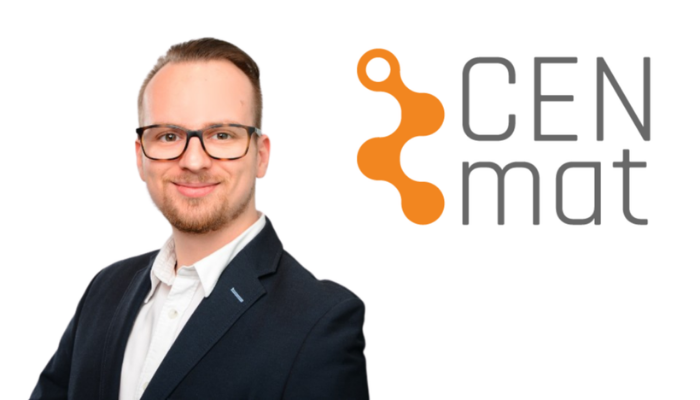
With a decade of experience as a polymer chemist, Julien Fage specializes in custom performance polymers and holds a PhD from Darmstadt University. Since 2021, he has been working at CENmat, where he collaborates with his team to develop polyelectrolytes for AEM and PEM water electrolysis.
More broadly, CENmat is a vertically integrated water electrolyzer company focused on the climate era. Its sustainable, scalable, highly efficient, and low-cost water electrolysis technologies enable the production of economical and truly green hydrogen.
What was your original motivation to become a researcher/project manager?
Already as a kid, I could spend hours trying to understand how things around me worked and how they could be improved. When I discovered chemistry, it was love at first sight. I wanted to work on something relevant to today’s challenges, and contributing to the green hydrogen field became an obvious choice.
What is your (main) research area today?
I am responsible for the development of highly efficient, cost-effective, and scalable polymers for water electrolysis, both PEM and AEM technologies. My work focuses on improving performance, durability, and processability while ensuring that the materials can be produced at industrial scale.
At CENmat, an important priority is the development of products that are free from so-called “forever chemicals” (PFAS). Therefore, a key aspect of my research is designing sustainable polymer solutions that combine high electrochemical performance with environmental responsibility.
What is the main focus of your team in SWEETHY?
Within SWEETHY, we are further advancing our AEM AionFLX™ by adapting it to the challenges of seawater, such as ion selectivity and resistance to scaling and fouling. We are working with our partners to determine the best strategy to increase membrane resistance without losing its conductivity. Additionally, we apply cost-effective and scalable processes to ensure that the methods can be successfully upscaled.
Could you describe your favourite moment/satisfaction when working for the project and – more in general – for your organisation?
In all EU projects, the best moments are when we all meet to share ideas or results. As this project is strongly application-oriented with a concrete goal, the meetings are key moments where each partner, with their specific objectives, presents their progress. Cooperation is essential, as each institute or company is a cog in a larger system.
How do you expect SWEETHY results will affect your organisation and the energy storage sector?
As a component and electrolyzer development company, we are aware that the availability of ultra-pure water is limited and increases the cost of hydrogen production. Therefore, working on direct seawater electrolysis offers a way to use a widely available resource while reducing both costs and the pressure on precious freshwater resources.