Direct seawater electrolysis offers a promising pathway for hydrogen production without relying on freshwater resources. However, salts, impurities, and challenging operating conditions present significant barriers to the development of electrolysers that are efficient, durable, and scalable.
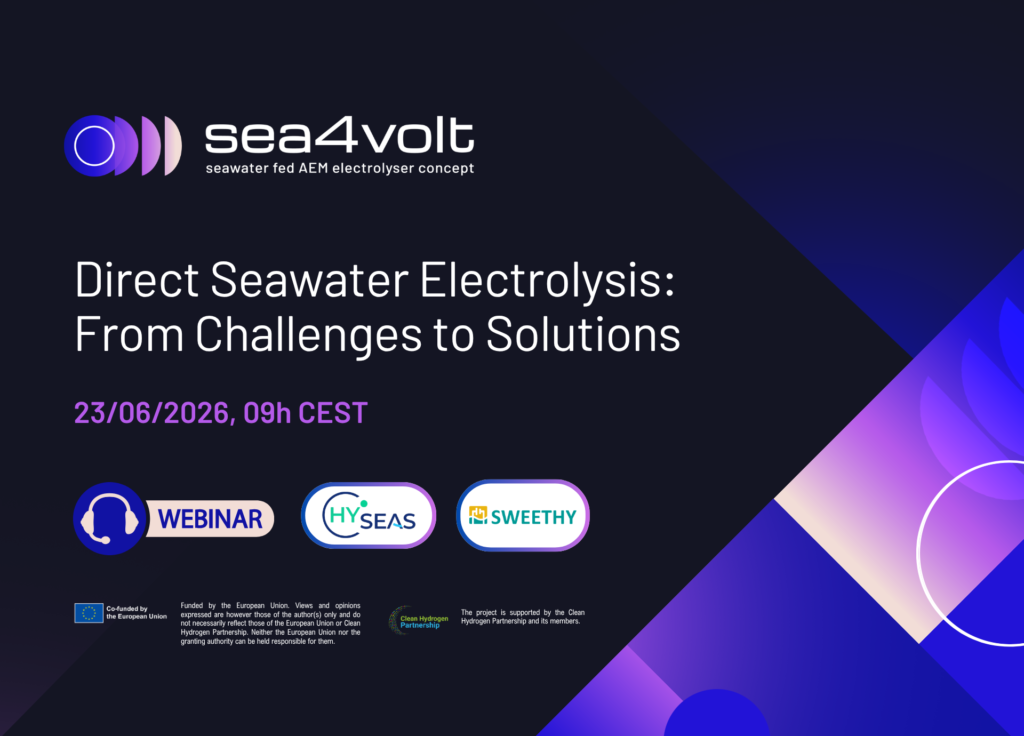
Bringing together the sister projects Sea4Volt, HySEAS, and SWEETHY, funded by the European Union and the Clean Hydrogen Partnership, this webinar will explore how researchers are addressing these challenges. Sea4Volt will present its work on corrosion, selectivity, and system efficiency, while HySEAS and SWEETHY will showcase innovations aimed at improving durability and long-term operation in seawater environments.
The session will conclude with a joint panel discussion and audience Q&A, focusing on the future of direct seawater hydrogen production and its path towards industrial-scale deployment.
Date: Tuesday, 23 June 2026
Time: 09:00–10:30 CEST (10:00–11:30 Finnish time)
Format: Online webinar
Register here.
Moderators
- Farhan Ali (Sea4Volt Project Coordinator, VTT)
- Milana Sekulic (Communication Manager, F6S)
Speakers
- Sassacha Morlock, Research Scientist, Fraunhofer IFAM (Sea4Volt)
- Dr Yagya N. Regmi, Reader in Energy Conversion and Storage, Manchester Metropolitan University (HySEAS)
- Julien Fage, Polymer Chemist, CENmat (SWEETHY)
- Olesia Danyliv, SWEETHY Project Coordinator, RISE Research Institutes of Sweden
Webinar agenda
09:00–09:02 Welcome and opening remarks – F6S
09:02–09:10 Introduction to Direct Seawater Electrolysis – Farhan Ali, VTT
09:10–09:20 Sea4Volt: Corrosion, Selectivity and System Efficiency
09:20–09:30 HySEAS: Materials and System Durability
09:30–09:40 SWEETHY: Materials and System Durability
09:40–10:25 Joint Panel Discussion and Audience Q&A, moderated by Farhan Ali (VTT)
10:25–10:30 Wrap-up and Closing Remarks – F6S